Tag: personal-growth

  • Something was off…

    Wednesday, May 20, 2026

    One thing about the group chat, somebody always has a story.

    One of my girlfriends and I go all the way back to college roommates. The kind of friendship where decades later you still laugh about the same ridiculous memories. Oatmeal creme pies stacked in the dorm room because campus meal plans basically starved us between lunch and dinner. Me playing Mariah Carey’s Butterfly album on repeat like I was going through a personal life crisis at nineteen. Somehow, almost thirty years later, we’re still laughing, still venting, and still helping each other survive adulthood.

    Recently she told me about her new job and honestly… the energy was off from the beginning.

    She had finally escaped one toxic boss only to land in an office where the dysfunction felt built into the culture itself. Her old boss was the kind of person who seemed to wake up looking for something wrong from overnight just to throw your energy off before the day even started. “Satan, not today,” type energy.

    But the new office? Different kind of chaos.

    Everybody talking about everybody. Gossip. Manipulation. Sexual relationship dynamics spilling into professional spaces. I mean literally. Backrooms. Closets. Corners. Meanwhile, all she wanted to do was work her eight hours and go home in peace.

    Then she offered to help one of her coworkers and her boss told her not to be so willing to help people because they wouldn’t do the same for her.

    I’m sorry… what?

    Since when did teamwork become a weakness? And your boss is the one promoting “self service”.

    The whole thing reminded me of showing up to a wedding in jeans and a white t-shirt. Technically, there’s nothing wrong with the outfit itself. It’s actually a classic combination. But for that particular environment? Completely wrong energy.

    And once the energy is wrong, even off, everybody feels it.

    That’s the thing people underestimate about workplace culture. One unhealthy person or toxic environment can spread like cancer. Which is why my advice to her was simple: protect your peace, document everything, and if the company doesn’t deal with the root cause, start quietly building your exit strategy.

    Because some workplaces don’t deserve your energy and protecting your peace is worth more than anything they can offer.

    To be continued…

  • Group Chat Therapy

    Sunday, May 17, 2026

    There was a time when therapy looked a lot different for me. It looked like random lunch dates with my girlfriends in the middle of the work week, stopping by somebody’s office just long enough to exchange one look before both of us started laughing, or quick “you busy?” texts after a stressful meeting. Back then, most of my family and closest girlfriends lived nearby. We were all balancing work, relationships, deadlines, and adulthood together in real time. Sometimes the conversations were serious. Sometimes they were completely unserious. Either way, laughter was always involved. And honestly? Laughter has always been therapy for me.

    Several years ago, I moved away for work and opportunity. Like a lot of people, I made the decision believing I was building a better quality of life for my family. Less traffic. Lower cost of living. Better schools. More peace. On paper, it made complete sense. And truthfully, in many ways, it was the right decision. But what nobody talks about enough is the emotional trade-off that sometimes comes with starting over somewhere new. The quiet distance between you and the people who once helped make life feel lighter.

    As I get older, I’ve realized I genuinely enjoy solitude. I like peace. I like quiet mornings and slower weekends. I like water features and backyard gardening. I like coffee on the deck watching the sunrise and wine in the evenings watching the sunset. That kind of thing. But distance has also taught me there’s a difference between enjoying solitude and missing your people. Because no matter how independent you become, there’s something healing about being around people who knew you before the stress, before the polished professionalism, before adulthood became one long calendar invitation.

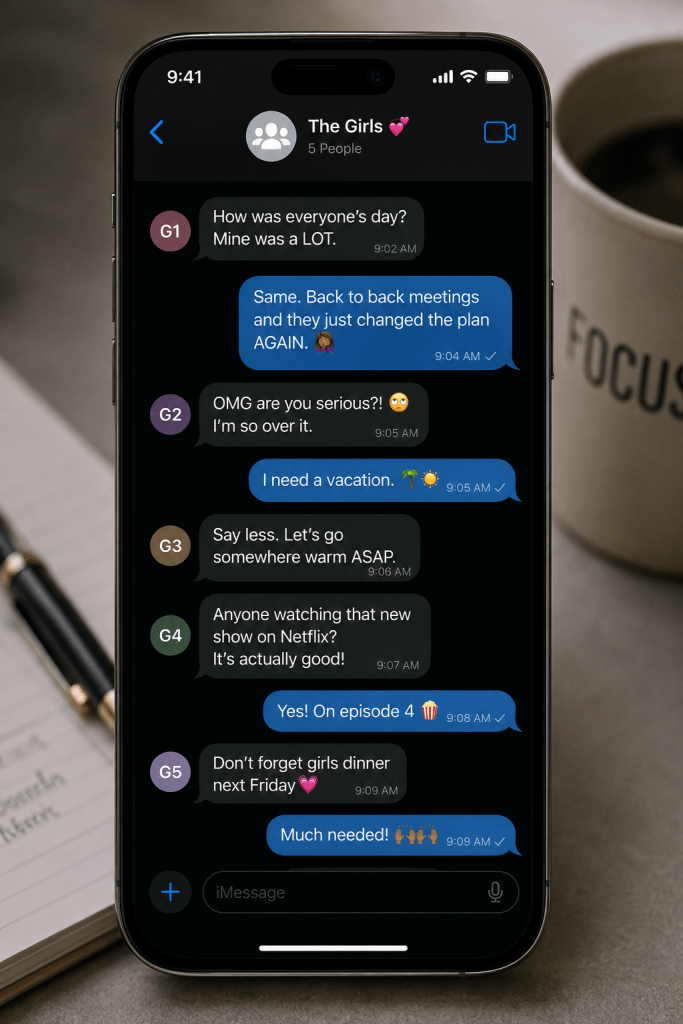
    So now, in between work schedules, different cities, and life moving faster than any of us expected, we have the group chat. One minute we’re discussing workplace drama, the next minute somebody’s sharing vacation ideas, binge worth shows, movie critiques, and then suddenly we’re deep into conversations about relationships, burnout, family, office politics, and whether any of us actually know what we’re doing anymore. Sometimes it’s serious. Sometimes it’s hilarious. Most times it’s both. But underneath all the jokes is something deeper: support. Real support. The kind that reminds you other women are carrying versions of the same weight too.

    And somehow the group chat became its own form of therapy. Oddly enough, fashion gives me that same feeling sometimes. It became therapeutic for me too. Not in the superficial “buy more things” kind of way, but in the creative sense. The same way some people garden, decorate, paint, journal, or rearrange furniture when life feels heavy. There’s something calming about playing with color combinations, textures, accessories, boots, bags, or even trying to style pieces you’ve owned for years in a completely different way. Fashion gives you room to reinvent yourself without having to completely reinvent your life. Some days it’s less about getting dressed and more about restoring a certain kind of energy.

    Honestly, I think we survive a lot more whether through shared laughter or style inspiration, than people realize.

    To be continued…

  • Assembly Required

    Monday, May 11, 2026

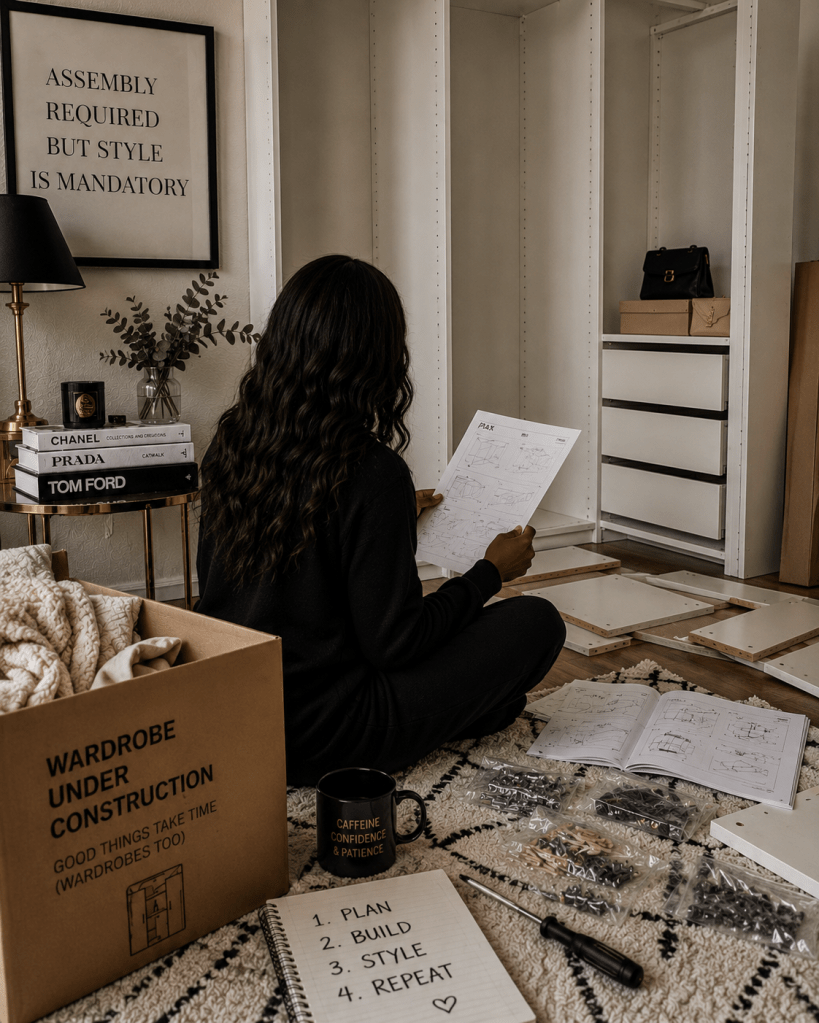
    There’s something both exciting and slightly dangerous about deciding to assemble furniture yourself. Especially the beautiful wardrobe systems online that look so clean, organized, and effortless in the photos. You see the finished vision immediately. The soft lighting. The neatly arranged shelves. The aesthetic storage boxes. The perfectly placed handbags and shoes. In your mind, the hardest part is already done…paying for it. Because let’s be honest, most of us choose the self-assembly version for one reason, it’s usually less expensive. A little more work upfront in exchange for the hope of getting the same polished result in the end.

    Then the box arrives.

    Suddenly there are wooden panels spread across the floor, hardware in tiny unlabeled bags, and instructions that somehow manage to say everything and nothing at the same time. And if we’re being honest, those picture-only instructions feel a little disrespectful. One tiny diagram is apparently supposed to explain an entire construction process while you sit there holding two identical pieces wondering why neither one fits the way it’s supposed to.

    And that’s exactly what these last few months at work have felt like.

    I was given a vision by leadership. A direction. A sample organizational chart showing what they wanted the division to eventually become. The assignment sounded exciting because I could build something from the ground up. The only problem? Somewhere between the vision and the actual building process, the vision and instructions started changing. Approvals slowed down. The division I’m supposed to establish started becoming the place where unresolved pieces, floating responsibilities, and “we’ll put this here for now” assignments quietly landed. The expectation to continue building the division in this dynamic never stopped and neither did the work.

    And that’s where flexibility enters the conversation. Not the polished, motivational speaker version of flexibility companies love to advertise, but the real version. The version where you’re adjusting in real time while still trying to the vision and produce something functional and polished. The version where communication matters because unclear instructions can change the entire outcome. The version where patience quietly becomes one of the most important tools in the room.

    Still, I think that’s why this whole experience made so much sense to me through a fashion lens. The most beautiful spaces, wardrobes, and even closet organization systems usually involve revisions, adjustments, missing pieces, and moments where you step back wondering if you accidentally assembled part of it backwards.

    At this point, I’m still somewhere between Step 4 and “insert wooden dowels carefully.”

    And honestly? I’m curious if anyone else has experienced this feeling lately, at work, at home, or even just trying to assemble something that looked much easier in the picture than it did in real life.

    Because so far, I’ve learned flexibility matters. Communication matters. Patience definitely matters. But most importantly, once you stop seeing the vision, there’s a problem.

    To be continued…

  • Values….Not Included

    Thursday, May 7, 2026

    The Accountability Gap

    The words change depending on what needs to be justified, and the values and standards only apply until something more important comes up. I’ve been in environments where phrases like people matter, customers come first, and leadership reflects integrity are repeated often enough that they start to feel like a given. It sounds structured, intentional, almost reassuring, like there’s a clear foundation guiding how things operate. But over time, you begin to notice the shift, not all at once, but in small moments where decisions don’t quite align with what was emphasized. A priority changes, a standard becomes flexible, or accountability seems to apply differently depending on the situation. And that’s when it starts to register that the messaging isn’t necessarily wrong, it’s just not consistent.

    What becomes more apparent is that it’s not a lack of understanding, it’s a matter of application. Values are easy to uphold when nothing is being challenged, when there’s no pressure or competing demand forcing a real decision to be made. But when those moments come up, the language adjusts to support whatever direction is needed, and what once sounded absolute becomes situational. It’s subtle, but it’s consistent enough that you can’t ignore it once you see it. You start to realize that some environments aren’t built on fixed standards, they’re built on what works in the moment. And once that pattern becomes clear, it changes how you interpret everything else that’s said.

    It reminds me a lot of clothing brands, especially the ones that rely heavily on image and messaging. There are pieces that look perfect on the hanger, structured, well-presented, styled in a way that makes you feel like you’re getting something of value. But once you actually wear them, you notice the difference in quality, in construction, in how well they hold up over time. The stitching isn’t as strong as it appeared, the fit doesn’t quite sit the way it should, and what felt like a solid investment starts to feel temporary. And that’s when you understand that something can be positioned as high quality without actually being built that way. It was designed to present well, not necessarily to perform well.

    At a certain point, you stop relying on what something claims to be and start paying closer attention to how it shows up, especially when there’s pressure involved. Because that’s where consistency either holds or it doesn’t, and that’s where the real standard reveals itself. It’s the same approach you take when building a wardrobe that actually works, choosing pieces that are reliable, structured, and consistent, not just visually appealing. You learn to pay attention to patterns instead of promises, to what holds up instead of what sounds good. And once you make that shift, it becomes easier to recognize what’s aligned and what only appears to be. Not everything that carries a label is built to last, and not everything that sounds right will hold up over time.

  • Out of Order

    Tuesday, April 7, 2026

    Somewhere between settling in and figuring things out, I’ve realized something. Have you ever been in a place, work or life, where things seem off? They just don’t make sense? Not in a dramatic way, and not in a “I don’t understand my job” kind of way, but in a way where you’re watching everything around you and quietly questioning how any of it is actually working. Everyone is moving, checking boxes, keeping things going, and yet you can’t shake the feeling that nothing is really efficient or effective. And isn’t that the goal? You stop and think, is it just me? Like you are in the Twilight Zone…does anyone see or care what is going on here?

    That’s where I am right now. It’s not loud or chaotic in an obvious way, it’s subtle, which almost makes it harder to define. My boss is calm, measured, a little hard to read, and not the type to call things out directly, but the frustration still shows up in conversations and side comments. It’s an energy I’m still trying to categorize, something that feels passive or maybe just unresolved. And I’ve seen this before, enough to recognize that when things aren’t addressed clearly, they don’t just go away, they build.

    So instead of getting pulled into that cycle, I adjusted how I move. Early on, I started writing everything down, following up conversations with notes and summaries to create clarity where there wasn’t much. I explained it was to help both of us, especially with how fast things were moving, and to his credit, he understood that. But even with that, I realized the notes weren’t the real issue. It was something bigger, like spring cleaning a space that looks fine at first glance, but once you start pulling things out, you realize how much doesn’t belong, how much has been sitting there untouched, and how quickly things can unravel if you’re not intentional about what stays.

    And coming from a place like that before, I knew that wasn’t how I wanted to start again. Starting fresh sounds good in theory, a new role, a new season, a clean slate; but the truth is, you don’t always walk into something new without bringing pieces of the old with you. It’s like building your spring wardrobe, wanting lightness, clarity, and intention, but still holding on to pieces that no longer fit or serve you. If you’re not careful, you end up recreating the same patterns you were trying to leave behind. And this time, I’m chose to be more intentional about what I carry forward.

    And maybe that’s what this season is really about—not just adjusting to new environments, but being intentional about what you keep and what you let go. Because whether it’s your workspace or your wardrobe, clarity doesn’t just happen… you create it. It actually reminded me of something I heard in a message this week—that order is necessary for things to run the way they’re supposed to. That everything was designed with a sense of order, even if we don’t always choose to maintain it. If you’re in a similar place, this might be a good time to reset both. Find your sense of order again, starting with what you can control. Sometimes, the easiest place to begin is your wardrobe.

    If you’re ready to create a little more order in your day-to-day, I put together a simple Closet Reset Edit to help you get started—one piece at a time.